On Petra Parker

I don’t remember the first time I encountered Peter Parker. Was it watching the 90s animated series? A VHS of the first Raimi flick? Was it reruns of something older, watched with my dad? I know that I loved Spider-Man from a young age. But like so much else of my childhood, it’s been lost in a dissociative haze.
What remains is that I thought he was very sad and very hurt, and that made me like him. I hated that he had to suffer in order to do what he thought was right, but it also made me feel strong. Spider-man showed me that being a little broken didn't mean you couldn’t still be a hero. That spoke to something deep inside me, something that I wouldn’t even begin to unpack until adulthood. But even then there was an emotional recognition of a fundamental truth:
Spider-Man was a hero for people like me. Not just one that would protect us. One like us.
So yes, Peter Parker is one of my favorite superheroes. He’s one of the few male heroes to make it onto my personal shortlist, and probably the superhero I’ve read/watched/played more of than any other.
I am ABOUT Spider-Man.
When I say that, I don’t mean I’m a fan of Holland, or Garfield, or Maguire, though I have seen every Spider-Man movie. Nor am I a fan by way of television (though I adored the 90s series and Spectacular), nor video games (though I have the Platinum trophy on all three of Insomniac’s games for the Webhead). I’m a comics bitch, first and foremost. I have read tens of thousands of comics in my life, and Spidey easily stars in a plurality of them.
I could absolutely tell you that my favorite superhero is somebody you know little about, or possibly never even heard of. I’m not seeking to engage in that peculiar, obnoxious pissing contest that so often pervades nerd spaces, but I absolutely could. But no, I’m not here to tell you how much I love Illyana Rasputina or Kitty Pryde or Elsa Bloodstone or Hazmat or Escapade or Nico Minoru or Dani Moonstar or Stephanie Brown or Renee Montoya or Galaxy or Dreamer or Scandal Savage or Kate Spencer or Zatanna.
I’m here to talk about everybody’s favorite hero: the Amazing Spider-Man. The Everyman Hero who is every man's hero. And hero to more than just men besides.
But recently, Peter Parker underwent a...metamorphosis, at least in fan circles. He was supplanted by a new, non-canon alternate: Petra Parker, the Spectacular Spider-Woman.
im gonna be honest i don't think i truly realized how much spider-man can work as a transfem allegory https://t.co/hCsXr27axB
— ❄️🎄Zappyz⚢🎄❄️ (@Zappyz_) August 14, 2026
Where it all began
Petra is hardly the first Spider-Woman. Jessica Drew has been around since the 70s, and both Julia Carpenter and Mattie Franklin have had their turn under the mask. And that's not even getting into alternate-universe counterparts, such as the Earth-65 iteration of Gwen Stacy more commonly referred to as Spider-Gwen, the MC2 iteration of Peter's daughter Mayday, or the alternate clone self of Ultimate Peter Parker (who adopted the name Jessica Drew) in the original Ultimate Universe. Petra is not like any of these Spider-Women. She is something different entirely.
Petra is like Peter in many ways. The difference is that Petra is a trans woman. She’s completely non-canon (though not entirely unprecedented given the complex history of Ultimate Jessica Drew), but that did not stop Petra from going viral, buoyed by an army of transexual Spider-Fans desperate to feel represented.
It actually makes a lot of sense that trans women would identify with Peter Parker.
There are the obvious reasons, the ones we share with tons of other people across the globe. He’s a hero for the working class, one who still has to balance bills against his superheroics. He has incredible powers, but not ones so divorced from regular human experience that they change how he moves through society. He grapples with everyday challenges as much as costumed villains, delivering stories where being late to a date can be just as devastating as a punch to the face.
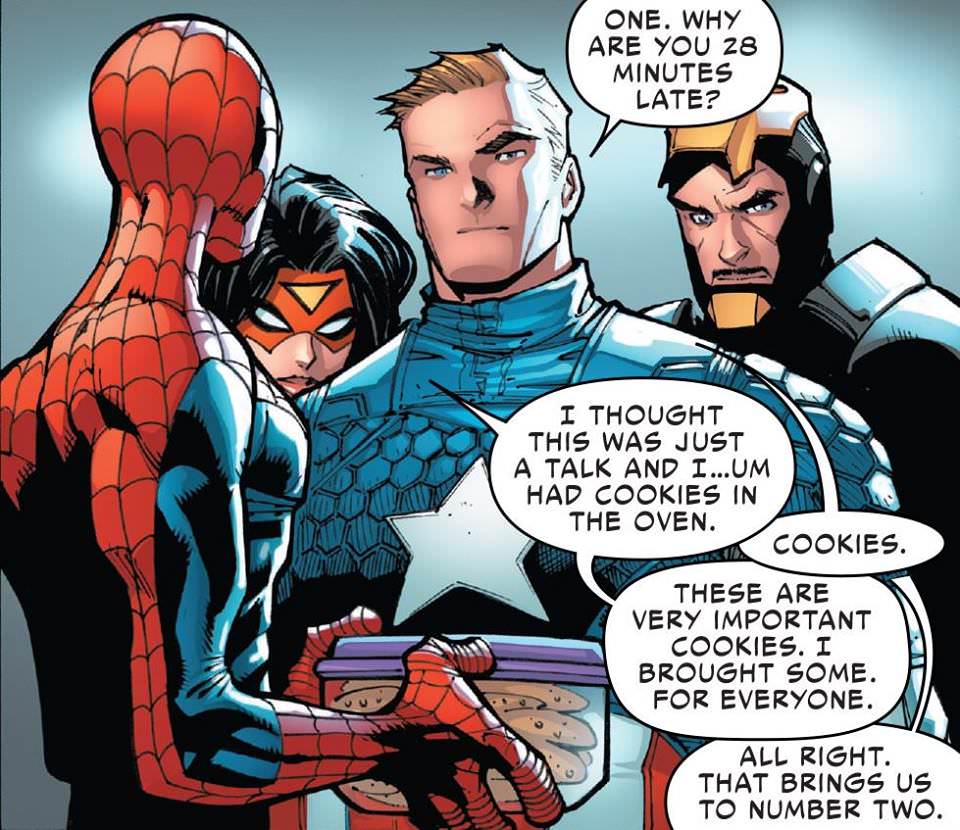
But there are also some reasons more unique to us. For instance, we know what it is to have our bodies go through unusual changes. We know what it is to have to hide who we really are so we can get by. We know what it is to have old white men in the media decide we’re the root of all societal ills for no goddamn reason. Many of us know what it is to attract and then fumble beautiful women through no fault of our own, and to have a variety of peculiar men develop psychosexual fixations upon us.
But the biggest reason that Peter Parker speaks to us, now and always, is because we know what it means to work hard, try our best to do the right thing, and still lose. To lose because we choose to be someone incompatible with the world’s idea of a winner. And to not only lose, but to lose while everybody else around us is winning.
Peter Parker is cursed with something often referred to as the “Parker luck.” Put simply, it’s a seemingly supernatural ability to get fucked over, time and again, mostly through no fault of his own. Even when his suffering is related to his own actions, it’s often entirely disproportionate to whatever sin he may have committed. Being Peter Parker, in a word, sucks.
Here are some examples:
-He’s orphaned prior to his first comics appearance.
-His uncle (and surrogate father) dies as an integral part of his backstory.
-His boss, upon whom he relies for a paycheck, actively organizes hate campaigns against him.
-His girlfriend’s dad gets killed during a fight with Doc Ock (Amazing Spider-Man #90).
-His girlfriend also gets killed soon after, this time by the Green Goblin (Amazing Spider-Man #121).
-Peter’s close friend and ally (Jean DeWolff) gets brutally murdered by a vigilante cop (Spectacular Spider-Man #107).
-He has been betrayed by more friends and mentors than I have time to discuss.
-He watched his archnemesis become the most powerful man in the American military-industrial complex (Dark Reign).
-He was hunted for sport on multiple occasions by a group of extra-dimensional energy vampires that wanted to kill (and eat) him simply for who he was (Spider-Man: The Other, Spider-Verse). In “The Other,” this actually results in Peter’s eye being torn out and eaten, with the injuries from the encounter resulting in Peter’s (temporary) death.
Part of what makes Peter so compelling is that despite the fantastical trappings of his suffering, his misfortune is still grounded in a way that feels very real. The focus isn’t on the fantastical, it’s on the human drama of his circumstances.
Every trans woman I know understands at least some of those feelings.
Most of us have lost family, or other relationships, just like Peter did, though not always via homicide. We know what it means to be hated or distrusted by people we care about. My relationship with my dad never recovered after my coming out. He was my hero, until the day he looked me in the eye and told me that me being trans was the worst thing that ever happened to him.
We’ve lost friends, or seen our friends turn into our enemies. The number of friends who just silently ghosted me after I came out is in the double digits. A couple abandoned our friendship more overtly. One insinuated to mutual friends that I must be a pedophile, on account of being trans and working as a teacher. When I was in my twenties, years before I came out, my first and longest-lasting friend opined to me how trannies were freaks and deserved to get shot. But at least I was never physically attacked like some of the girls I know.
We’ve been forced to work for bosses who hate us, or at least hate what we are, just as J. Jonah Jameson hates the Wallcrawler. I once had a supervising administrator who pretended to support me, only to start he/himing me when she couldn't coerce me into breaking the rules for her. I've had friends get fired, get blacklisted, get sued by transphobic bosses.
In the same way that Peter has to constantly watch out for attacks from his costumed foes, we are dramatically more likely to be victims of violent crime (up to and including rape and homicide), with the likelihood increased an order of magnitude for black trans women, native trans women, and other more marginalized parts of our community. We have been trapped, ambushed, and attacked.
Peter's experiences living a dual life create a potent subtextual reading due to how they dovetail with common aspects of queer existence. There’s a power to that. We’re left with a man who might actually be able to understand what we go through, even if he isn’t exactly like us.
But what if he was like us. What if SHE was like us?
Enter Petra Parker.
Now, technically the idea of Petra Parker predates the recent social media trend. There was a preexisting character named Petra Parker (in the Ultimate Spider-Man animated series) who was an alternate version of Peter Parker that just happened to be a woman. However, it should be noted that at no point is it ever indicated that the original Petra is trans. Rather, the implication is that she is and always has been a cis woman, from a universe where everybody’s gender seems to be swapped.
More importantly, an abundance of the art of the recent iteration of the character is clearly anchored on the idea of Petra coming out and transitioning in a primary canon iteration of the Marvel universe. She was previously named Peter, and she lived through the things Peter lived through, whether that’s in the comics continuity, one of the shows, or one of the movies. This is important because it anchors Petra’s story as HER story. She’s not just an alternate for the “real” Spider-Man. She’s a re-imagination of THE Spider-Man into THE Spider-Woman.
He's not transphobic, he's quite respectful
— ARZER COMMISSIONS CLOSED (for now) 🇦🇷🏳️⚧️ 5/5 (@arzergex) August 12, 2026
he just really hates Spidey. https://t.co/hxPklcw1QX pic.twitter.com/kXUv7Vufje
And clearly this stuff is striking a chord. You can go looking for it, and you will find hundreds of works, everything from pieces of professional art to full-featured fanfics to someone's very first sketch, with a collective support measuring in the hundreds of thousands (if not millions) of likes, shares, etc. A lot of people, especially a lot of trans women, are compelled by the idea of a transfeminine Spider-Woman. I think it's because trans-femininity and Spider-powers go together like peanut butter and chocolate.
The art itself varies, ranging from heartwarmingly saccharine to distressingly real. But the common thread is that so very much of it feels authentic to what came before. Peter already represented so much of our experience. Petra offers a way by which we can codify that connection, even if she isn't canon.
And that matters, immensely. Trans women are not gifted with an abundance of representation in mainstream art. Much of what we have exists at the margins, lip service paid through secondary and tertiary characters who are only confirmed queer in offhand comments or supplemental materials. If we want to really see ourselves, we have to carve out the space ourselves.
And we do. There is a whole host of art created by trans women and trans femmes, though it is usually still relegated to the outskirts of popular culture. But so many of us have written, drawn, recorded, animated art by us, for us. I've even tried my own hand at it.
We even have a few trans superheroes these days, like Escapade, Galaxy, and Dreamer. But even these characters, the zenith of our foothold in the superheroic sphere, do not appear in publication nearly as regularly as the A or even B-list. And Spider-Man...Spider-Man has always been something beyond the A-list.
Petra is special because for once, our attempts to build a place in the heart of culture worked. They went viral. For just a little while, people were celebrating OUR Spider-Woman.
There’s one last thing I love about Peter Parker, and by extension Petra too.
It’s that she does not let the cruelty of the world turn her away from doing good. Sure, she falters sometimes. She makes mistakes. But she always, always picks herself back up and tries to do good again. Because she can, therefore she must.
I love it because I see it in my sisters too. We have, as a demographic, been brutalized by this world. I am so much luckier than so many of my fellow trans women, and yet I have suffered at the hands of a society that hates me. I have been threatened to my face. I have had people publicly wish that I would die. I have had people take advantage of me, abuse me, assault me. I have been called so many awful things. Yet so many of the girls I know have been through worse. It would be forgivable for us to embrace misanthropy, or outright nihilism.
And yet so many of us don’t. Every day, I see my sisters pick themselves up, dust themselves off, and continue to live. I see them continue to do good. I know they’re sad and hurt, I know they are a little broken. But they’re still here, they’re still living, they’re still striving towards a better world. They're volunteering at soup kitchens, working in non-profits, engaging in protest and activism. Recently, many of them engaged in the exact political organizing that might just pull the US back from the brink. But even when they aren't working on the big picture problems, there's still a community mindedness among us that brightens even the dark days.
Honestly, that has saved my life. The kind words of a fellow trans girl, delivered right as I wanted to give up, go away, disappear...those words helped me hang on a little longer, until I could get my feet back under me and stand on my own once again. In that moment, she was my hero.
Just like Peter. Just like Petra.
So…maybe I can be that kind of hero too. I'll never bench press a city bus, but I might be able to help people. Maybe I can feed the hungry, advocate for my community, organize for a better tomorrow. If nothing else, I might be able to offer a kind word or assistance to someone in crisis.
And if I can do that, then I must. Not because I have to, but because that’s who I want to be. Petra might not be canon, might be even less real than Peter Parker, but she becomes real when I hold her in my heart and reach out a helping hand.