You Don't Have to Grow Up, but You Do Have to Grow

This was supposed to start with Harry Potter.
By that I mean that this piece was initially conceived with Harry Potter as the hook. But as is the way of the 24 hour news cycle, I got an even more perfect example dropped directly into my lap.
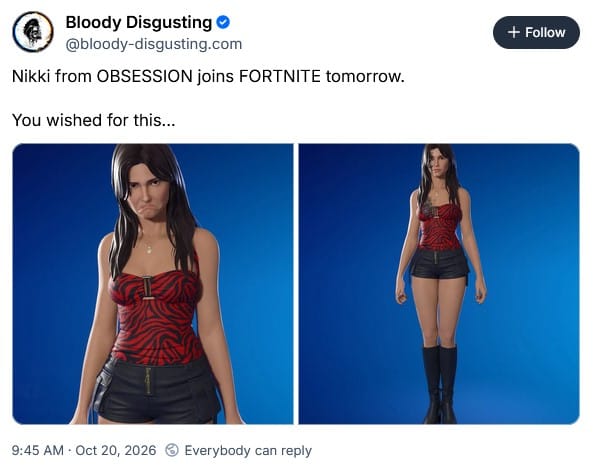
Look at it, so perfectly representative of the Ready-Player-One-pilled mind. Nikki from Obsession, now in Fortnite! You can wear her hollowed-out skin, meta-textually perpetuating the horrors to which she has been subjected. And you can make her do lots of silly dances while you do it! We're reaching all new levels of objectification, folks.
What’s worse is that this is hardly a new phenomenon. It isn’t even the first time in recent memory that Fortnite has committed this sin, lest we forget the grotesque overreach of “Kingdom Hearts with guns.”
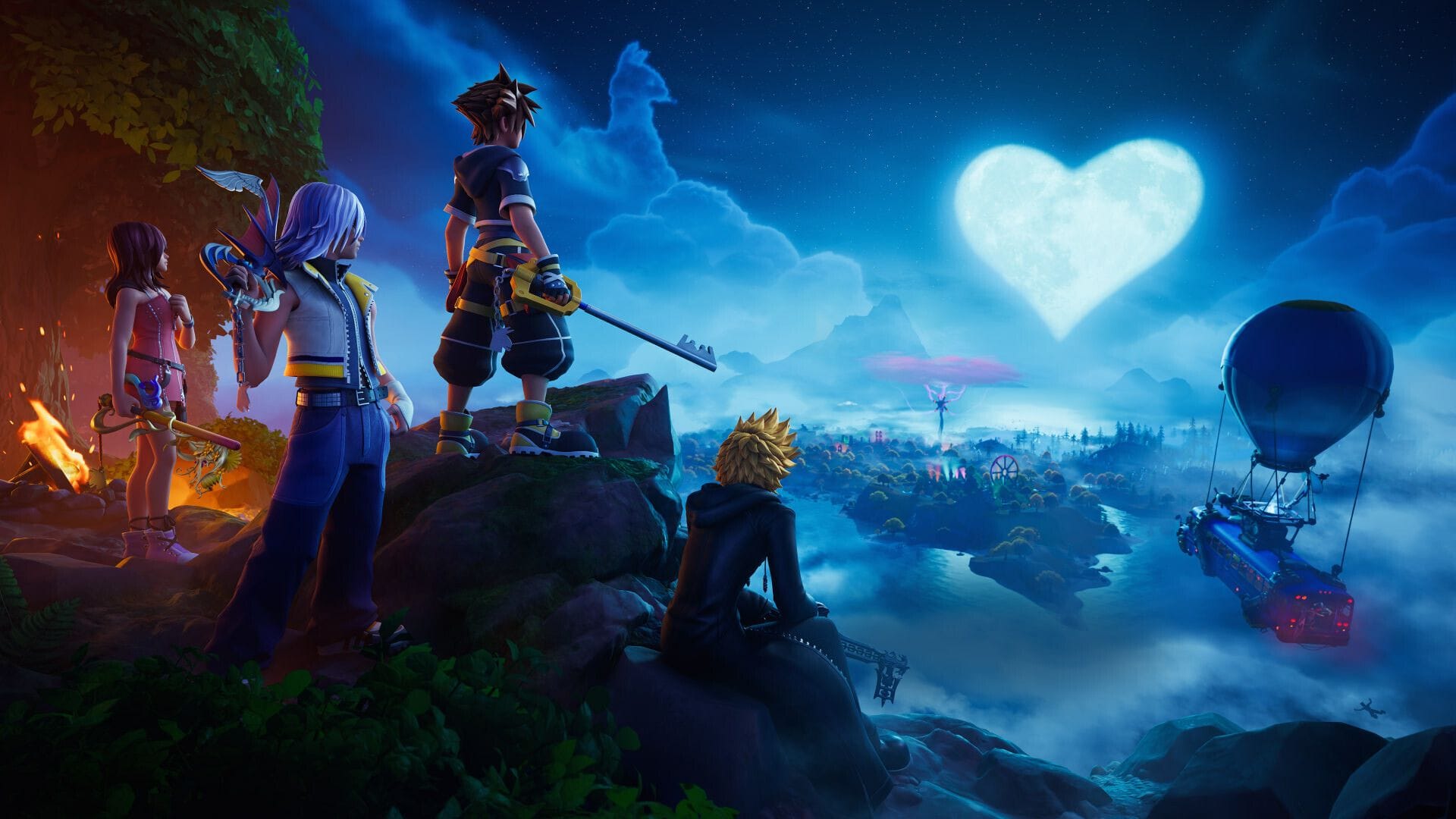
It’s simply another example of art being rendered down to an aesthetic signifier, a gaudy sign that reads “I know about this thing” while profaning the original work and removing that which makes it matter. It’s strip-mining sincere art for aesthetics, thus allowing fans to use those aesthetics to construct an identity. You don’t have to be you, you can style yourself however you want, crafting an identity and ersatz community out of a monetary exchange. It’s a sort of empty signaling that feels more and more rampant these days. And yet, it does not begin here.
Thus do I return to Harry Potter, because this same principle lies at the heart of that baneful work. The difference is that Harry Potter required little hollowing out. It was selected by corporate interests, and then precision-engineered to a singular purpose: to sell merchandise to kids.
The story has always been that Harry Potter’s massive success came from an organic appeal to young minds. It grabbed the attention of young readers with its simple yet compelling magical hook. Then, once it was popular with kids, the storytelling matured and grew over the span of seven books, meaning that they were appropriate for teens by the time that first group of readers reached high school.
That’s the story. It’s only half true, but that is the story.
Sure, the book had legitimate success in the UK in the late ‘90s. A big part of that is that it appealed to the childish desire to be special, that small dream that one day you would discover that the things about your life that you hated were never supposed to happen because you had a Destiny. It's an attractive proposition, especially to a kid. It's also a rather insidious one, considering the risk that it could reinforce delusions of protagonism.
But the reason it blew up in the American market wasn't because of what was in it. It was because it got a mass multi-media push. The books were the centerpiece of every Scholastic Book Fair in the US, accompanied by a cavalcade of merchandise ripe to influence young minds. They were soon followed with a film adaptation, which drove up demand even further, which snowballed further. Before long, Harry Potter was a staple of Halloween costumes, white lady mood boards, and regrettable tattoos.
Even as a trans woman, part of a group who has been in old JK's sights for years, I don't begrudge people the joy that this series brought them when they were kids. Nor am I telling them they have to smother the part of themselves that felt that joy. I'm just saying that if a person is still fixated on their favorite book from childhood, they aren't doing enough to explore what else the world has to offer.
I will say it plainly: Harry Potter was a coordinated effort by the corporate interests at the heart of the mono-culture. Any quality it had was entirely secondary to its marketability. The books were a trojan horse to sell a lifetime obsession with wands and houses and Bertie Bott's Every Flavour Beans.
The books AND the merch were then being pushed to impressionable children, directly in public schools. A thousand tons of plastic waste-in-waiting, delivered directly to every ten-year old with a couple dollars to rub together. Those Scholastic Book Fairs were not, despite what many teachers of the era would have told you, creating life-long readers. They were cultivating consumers in controlled environments.
Now here we are, damn near thirty years after that first book launched, and we are seeing the same scenario play out. It’s not Scholastic this time, but Warner Brothers, but once again, Harry Potter (this time the show) is receiving a coordinated corporate push. Have you noticed how many Harry Potter references just coincidentally end up in WB properties? It happened like three times in Lanterns (which I found infuriating because Guy Gardner would NOT SAY THAT).
I’m not here to spend time reciting the evidence of JK Rowling’s many sins against the trans community, though they are numerous and well-documented. I am also not here to write about her lack of aptitude for the craft, though I certainly might under different circumstances. I am here to tell you that fixating on Harry Potter was bad for you before Rowling became a bigoted ghoul, and it would still be bad for you even if her grasp of prose was excellent.
Because the problem is that people are consuming content that’s delivered to them instead of seeking out art to experience. That passivity permits one’s worldview to be limited without one's consent. If you aren't throwing a wide net, you will get what you get. You might still receive a selection of options from which you can choose your favorites, but the choices were set before you even began.
If you don’t believe me, go ahead and read up on some of the current controversies with Scholastic, and how all of their diverse book offerings are confined to a single, optional setup so that schools in conservative areas can safely “protect” children from learning about queer people, or black people, or immigrants, etc. Take a look at how not just WB, but all of the major studios have allowed their LGBTQ representation on-screen to crater in the past few years. Ask any author from a “diverse” background how much harder it has been to get through the traditional publishing gauntlet lately. Being passive when it comes to art helps enable fascism.
I think about this all the time, because in my day job I'm a high school English teacher. I've watched how the world has become more and more hostile to, or at least unsupportive of, exploration. I've watched how the rise of streaming and algorithmic social media has stripped our lives of the so many routine chances at discovery. Kids these days aren't worse or dumber or less worthy than we were. But they exist more and more within a prison of data, optimized to extract maximum engagement, development be damned. Every child in America, and beyond, with a machine-devised content diet tailor-made to sell them things they don't need.
But the kids still crave self-expression, they do. They want individuality: we all do. That's part of the tragedy of all of this. The world just isn't set up to permit it anymore, at least not without some real effort.
It’s not just Harry Potter-by-way-of-Scholastic-Book-Fairs, and it’s not just Fortnite. It’s the YouTube algorithm, and Meta, and X, and all algorithmic social media. It’s everything where corporate interests are curating winners and losers before the general populace gets a chance to make up its own mind. In that kind of setting, there's no discovering a new favorite show because that's what happened to be on tv. There's no checking out an unfamiliar genre of game because that's all your friend had. There's just endless pablum.
Now am I saying that you should never enjoy any sort of corporate IP? No. That’s not a workable strategy, and anybody that tells you it is must be isolating themselves from the dominant culture to a debilitating extent. Personally, I like superhero comics far too much to ever front in such a way. Though, for the sake of clarity, I do think you shouldn't engage with Harry Potter and Fortnite.
What I’m really saying is that you need both volume and variety in your media diet, and that you will have to be intentional in pursuing both. The answer isn’t to limit what you read/watch/play. It’s to expand your reach. It's fine to engage with corporate art, but you should engage with a lot beyond it, and you should stay cognizant of what might motivate it and what its limitations might be.
So that's why I'm blogging again. Because I want to push myself to search further, and I want to help others do the same. So here are a few goals for this new site:
- I will make a continual attempt to explore the new. Not just new games, but new genres, new mediums, new experiences in general.
- I will avoid re-treading ground where possible, unless I am promoting it to new eyes.
- If I revisit a work, even if I'm trying to help others see why it's cool, I will still try to examine it anew. Beauty is found in the nexus between the work of the artist and the experience of the viewer. Even if the work remains the same, if the viewer has changed, so too can their experience with the work. This is to be celebrated, and I will celebrate it.
- I will stay wary of corporate art. I will note its flaws frequently and exuberantly, and I will try to balance discussions with independent media when I can.
Those are my pledges to you.
Now, you don't need to pledge anything to me. But if you were going to, a great place to start would be this:
- That you won't watch the Harry Potter show. That you won't dress up as Harry Potter or any related characters for Halloween. Essentially that you will stop doing things that give that horrible, horrible woman money or cultural clout, not just for me, not just for trans people, but for your own development and wellbeing.
- That you won't play Fortnite, and you certainly won't pay real American dollars to purchase a Nikki-from-Obsession skin. You will be better off, I promise.
- That you will go out and find something, anything made by a human that wasn't spoon-fed to you by a corporate algorithm or PR team, and that you will embrace that thing and engage with it in sincerity and reverence and a critical eye.
- That if you find a new thing that excites you, you'll tell a friend.
If enough of us do those things, I think we'll all turn out alright. Because if we all do that, then we're all growing, exploring, becoming a newer and better version of ourselves. And I choose to believe that can be enough.
We have to let ourselves grow beyond what we were obsessed with in childhood, or last year, or last week. We have to stop thinking about the last thing, and start thinking about the next one. Go out and discover. Free your mind from what the corporate-imperial core has devised for you.
And hey, if you're having a hard time coming up with new stuff to discover, check back here later. I've got some ideas.